Hardwood flooring in Union City is installed by a licensed remodeling contractor who examines the subfloor, selects the wood flooring that suits the house and schedules the job after the messy work is finished. The flooring is part of our remodeling projects at Construction Remodeling in Bay Area. Therefore, you will be provided with a fixed written price and a free estimate.
By Ray Evgeny Khaikin, Owner & General Contractor · Last updated October 14, 2026
Solid hardwood is one piece of wood milled throughout, whereas engineered hardwood uses glue to attach a hardwood veneer to a layered core. This subtle difference has ramifications throughout the rest of the board, so it’s good to know the differences. Weigh the pros and cons of engineered vs. solid hardwood Union City homes can support. Begin your research by looking at the underlying surface and the table.
|
Solid hardwood |
Engineered hardwood |
|
|
Construction |
One piece of wood, top to bottom |
Real-wood layer over a layered core |
|
Reaction to humidity |
Swells and shrinks more |
Moves less, so it’s more stable |
|
Refinishing |
Can be sanded several times |
Depends on the thickness of the top layer |
|
Over a concrete slab |
Generally not recommended directly |
The usual choice, glued or floated |
|
Best for |
Wood subfloors and long-term refinishing |
Slabs, whole-home runs and changing humidity |
The thickness of this top layer determines how many times the floor can be refinished, so ask the seller for the number on the wear-layer specification. If you’re shopping for hardwood flooring installation Union City, before you choose a color, ask what’s beneath the finish, because it will dictate your options.
Our own materials guide lists engineered hardwood as the whole-home pick for durability. One more thing is worth knowing, though. Engineered boards with plywood cores fall under federal limits on formaldehyde, and compliant products carry a label. The EPA explains the formaldehyde standards for composite wood products, so look for the TSCA Title VI label before you buy.
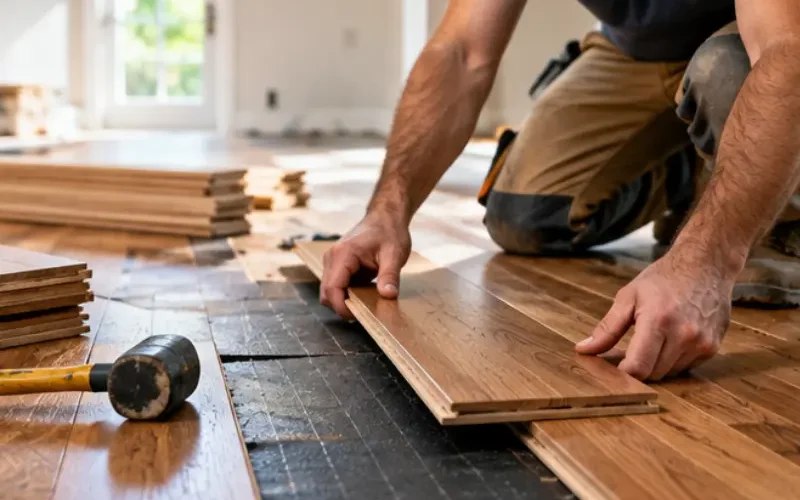
Because concrete retains and releases moisture and wood swells, cups and buckles when exposed to that moisture, will hardwood work over a concrete slab? Yes, provided that the slab tests to be dry, the appropriate products are installed and the proper barriers are placed underneath.
Here’s how it usually goes. Most contractors will recommend using engineered hardwood for the installation over a slab, and will either glue it down or allow it to float. While solid hardwood can also be used over a slab, there needs to be a ply subfloor system over a vapor barrier which adds height and cost to the project, so many people choose to use an engineered product instead. In either case, the moisture content of the slab is tested prior to ordering any wood.
A glue down or floating? A glued floor will adhere to the slab and feel more substantial, while a floating floor will have an underlayment and be comparatively quicker to install. Instructions for each have specific requirements from the manufacturers so that the warranty will remain valid, and concrete generally has to cure for a period of time before any installation is begun.
Flatness is an important concern as well, as concrete slabs are rarely perfectly flat, and in the past carpeting has been used to mask minor imperfections. Wood will find those imperfections out, and valleys will need to be filled and hills ground down before beginning the installation, which is then followed by acclimation, the process of allowing the board to settle in the house to equalize the moisture content. If the slab has radiant heat installed, make sure to inform your contractor ahead of time, as fasteners and adhesives will have to be different.
The one who talks about moisture and flatness, instead of leading with color. Which contractor near me lays hardwood over a slab? Ask each bidder these questions, and compare the answers:
We work under CSLB license #1095283 and give you a fixed price in writing, so the prep appears as its own line, not as a surprise later. Also, if you’re remodeling anyway, our home remodeling page shows how flooring fits into a full project.
A contractor who treats prep as its own job, instead of a favor thrown in at the end. Booking subfloor preparation for hardwood Union City? It’s the unglamorous half of the work, and it decides whether the floor lasts.
Prep usually covers these steps:
On a raised foundation, the subfloor is typically constructed of either sheets of plywood or boards laid over supporting joists. Squeaks and flexes tend to happen right away over wood, so the solution is to secure the subfloor into the joists rather than leave it be. Many houses in Union City are tract homes built from the 1960s to the 90s, and some are on slabs while others are on raised foundations. Don’t assume; check what you’re working with before choosing a product for your floor.
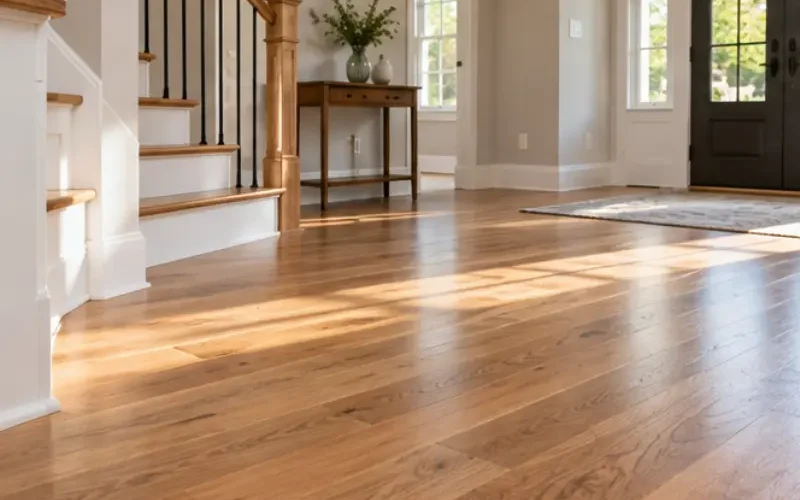
Near the end, after the messy work and before the final trim and paint touch-ups. Should flooring be done before or after other renovation work? After the dusty, heavy trades, because drywall dust, paint drips and tile saws are hard on a fresh floor.
A typical order looks like this:
Why does the air matter? Wood takes on moisture from the room, so many manufacturers want the heat or cooling running and the house at normal conditions before and after installation. Check your product’s instructions, then plan the schedule around them.
Kitchens add one wrinkle. Some crews floor first and set cabinets on top, while others floor up to the cabinets. Decide it at the start, and write it into the contract. The state licensing board says home improvement projects over $500 need a written contract, and that any change must be in writing too. It also says a down payment shouldn’t exceed 10 percent of the price or $1,000, whichever is less.
We work out of Hayward, and we also serve Union City, Fremont, Castro Valley and San Leandro. Flooring can be its own project or part of a kitchen, bath or whole-home remodel, so tell us the full scope at the estimate. Our Union City page covers the area, and our window installation guide for Union City tract homes covers another common upgrade for the same houses. Then, when you’re ready, request a free estimate or call (510) 990-9243.
It depends on what’s under the floor. If you have a concrete slab, engineered is usually the safer choice. However, if you have a wood subfloor and want a floor you can sand many times, solid may suit you better. Our own materials guide lists engineered hardwood as the whole-home option for durability. Tell us the foundation type and we’ll recommend one at the estimate.
Yes, with the right product and prep. That means engineered hardwood, glued or floated, over a slab that has tested dry, with a barrier where it’s needed. Solid hardwood generally isn’t laid directly on concrete. Ask any contractor for the moisture reading, because that number tells you whether the slab is ready.
Usually, yes. Flooring goes in after drywall, tile and most painting, and before baseboards and final trim, so dust and drips don’t land on it. The exception, though, is a single room with nothing else going on. We set the sequence in the written schedule, so everyone knows when the floor goes in.
It depends on the subfloor. A slab may need a moisture test, a barrier and leveling, while a wood subfloor may need re-fastening to stop squeaks. We price prep as its own line in our fixed-price quote, so you see what it costs. That way nothing about the prep is a surprise on installation day.
Yes, removal and disposal can be part of the job, and we list them as lines in the quote. Tell us what’s there, whether carpet, tile, vinyl or glued wood, so we can scope it. Older adhesives and paint can need special handling, so we check before anything comes up.
You can reach us at (510) 990-9243, Monday to Thursday, 8:00 AM to 6:00 PM, and Friday to Sunday, 9:00 AM to 4:00 PM.
Construction Remodeling in Bay Area 111 Jackson St Hayward, CA 94544
Phone: (510) 990-9243
Hours: Mon–Thu 8:00 AM–6:00 PM · Fri–Sun 9:00 AM–4:00 PM
CSLB License #1095283. Serving Union City, Fremont, Hayward, Castro Valley and San Leandro.