Landscaping in Mountain View, CA works best when it’s planned around local soil conditions, dry summers, drainage, water use, and city requirements—not just plant preference. A landscaping company Mountain View CA homeowners can rely on should consider how well the soil drains, which plants can handle the area’s climate, how much irrigation the yard will need, and whether the project requires permits or qualifies for local rebates. Planning these details first can help prevent drainage problems, wasted water, and costly changes later.
Construction Remodeling in Bay Area (CRBA) can help homeowners evaluate these factors as part of a broader landscape, grading, or remodeling project.
By Ray Evgeny Khaikin, Owner · Last updated 14 August 2026
Most landscaping problems we see in Mountain View aren’t design problems. They’re site problems that never got fixed. The Santa Clara Valley floor has heavy clay soil. It swells during rainy months and cracks during the dry season. Poorly graded plant beds can trap water near the foundation. Lawns on heavy clay can also dry out quickly once summer arrives.
We see this often during additions and backyard remodels. Regrading around a new footing or patio slab can reveal poor drainage. That’s why every good landscape design Mountain View project should start with the site. Check the soil and grading first. Choose the plant list second.
Older areas such as Old Mountain View and Jackson Park often have clay-heavy beds. Many date back to the 1940s and 1950s. These beds may never have received proper soil amendments. Newer homes near Willowgate and Sylvan Park often have better base grading. However, they may have shallower topsoil. That difference can affect which plants establish successfully.
Bay Area landscaping typically runs $10 to $25 per square foot for softscape work (plants, soil, mulch, basic irrigation) and $25 to $75+ per square foot for hardscape (patios, pavers, retaining walls) — noticeably higher than the national $4.50–$20 range, mostly because of local labor rates and slope or drainage work most flat-rate national estimates don’t account for.
For a typical Mountain View property, that generally shakes out to:
Sloped lots, poor drainage, or tree-root removal push costs toward the higher end of every range above — which is exactly the kind of site issue a design-build team is set up to catch before you sign a contract, not after.
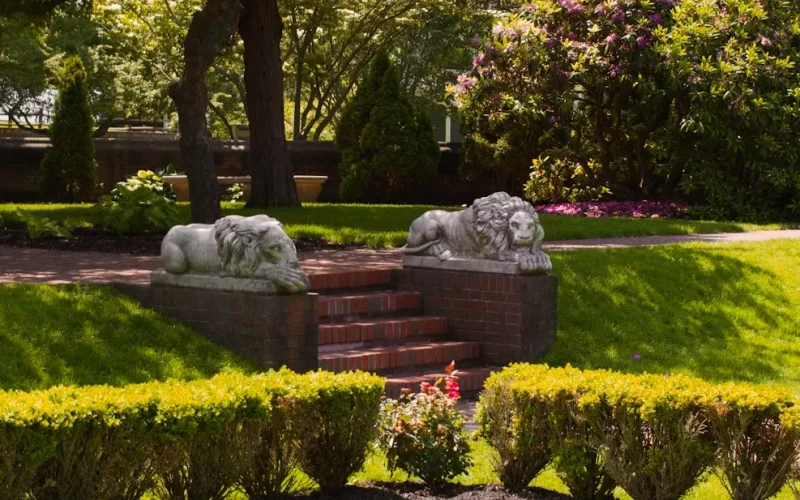
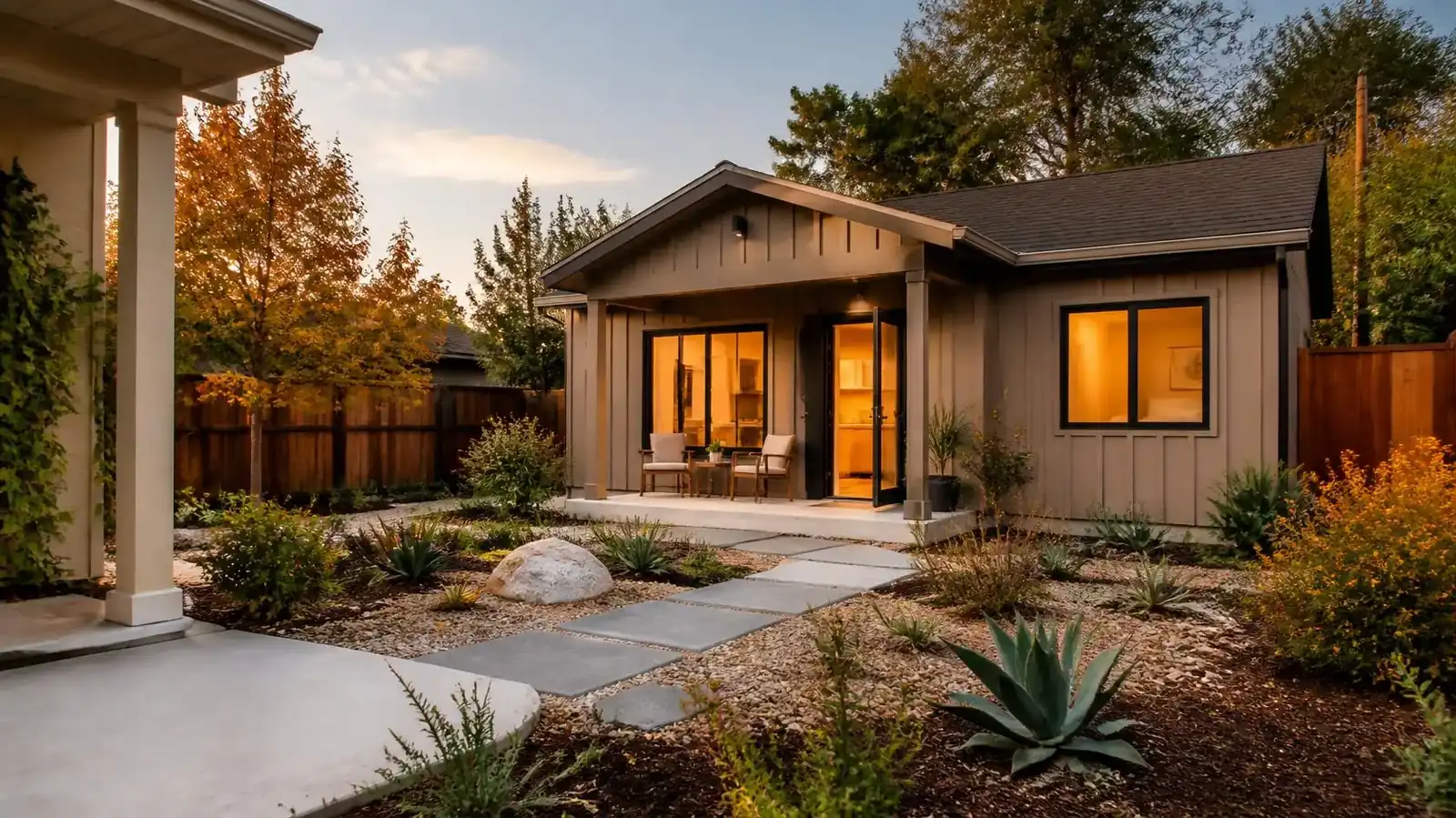
The best-performing yards in Mountain View use California natives and Mediterranean-climate plants. These plants handle dry summers and wet winters well. They need less water than imported turf varieties.
Reliable plants for this microclimate include:
Group plants by their water needs. This practice is called hydrozoning. It helps mixed plant beds stay healthy. Avoid placing thirsty hydrangeas beside drought-tolerant sage. One plant may get too much water. The other may not get enough.
A drought-friendly yard starts with hydrozoning, drip irrigation on a smart controller, and mulch — in that order. California’s Model Water Efficient Landscape Ordinance (MWELO) sets the baseline most new landscape permits are measured against, and it rewards exactly this approach: right plant, right water zone, minimal overhead spray.
Practically, that means:
Homeowners converting a lawn in Mountain View’s water district can also apply for the Valley Water Landscape Conversion Rebate, which currently pays per square foot of qualifying turf removed — worth checking before you finalize a design, since it can offset a meaningful chunk of the softscape budget.
If you’re searching for the best landscaping company near me Mountain View CA, check the contractor’s license first. California generally requires a C-27 landscaping contractor for planting and irrigation work. Grading, drainage, retaining walls, and related structural work may require a general building license. CRBA’s CSLB #1095283 covers the work we handle.
That’s where we fit in. We handle drainage, grading, patios, and retaining walls. These services often form part of a larger remodel or addition. For softscape work, we coordinate with a licensed planting and irrigation partner. This approach keeps each part of the project under the right license.
If you’re comparing a landscape design company Mountain View California homeowners can hire, ask about licensing. Confirm which license covers each part of the work. Do this before you sign a contract
We do our grading, drainage, and hardscape work throughout Old Mountain View, Blossom Valley, Jackson Park, Willowgate, Sylvan Park, and the Whisman Station area, plus neighboring Palo Alto, Sunnyvale, and Cupertino. Most of it happens alongside a room addition or whole-home remodel, where the yard gets disturbed anyway and it’s the right moment to fix drainage for good.
If you’re typing landscaper near me Mountain View into your phone mid-project, that’s usually the sign: a patio slab is holding water, a retaining wall shifted, or a new addition left the backyard grade a mess.
One local note: most straightforward planting projects under 1,000 square feet don’t need a city permit in Mountain View’s residential zones. Anything involving a retaining wall over 4 feet, a non-wood fence, or 1,000+ square feet of new landscaping tied to another permitted project does. More in the FAQ below.
How much does landscaping cost in Mountain View, CA?
Most projects run $10–$25 per square foot for planting and irrigation, and $25–$75+ per square foot for patios, walls, and other hardscape. A full backyard landscape typically lands between $20,000 and $55,000.
What plants are best for a drought-tolerant CA yard?
California natives and Mediterranean plants — ceanothus, manzanita, yarrow, deer grass, rosemary, and lavender — handle Mountain View’s dry summers with minimal irrigation once established.
How do I design a low-water landscape?
Group plants by water need, switch to drip irrigation, mulch heavily, and remove non-functional turf first. California’s MWELO standard is a useful baseline even for projects that don’t legally require it.
Do I need a permit for landscaping in Mountain View?
It depends on the type and size of the project. Simple planting and landscaping work under 1,000 square feet in residential areas generally does not require a permit, while projects involving retaining walls over 4 feet, certain fences or walls, or work connected to another permitted project may require one. Check the city’s current requirements before starting work.
What landscaping adds the most home value?
Front yard curb appeal and low-maintenance, drought-tolerant design tend to add the most resale value relative to cost — several real estate studies put the boost in the 5–15% range, though results vary by neighborhood and existing yard condition.
Construction Remodeling in Bay Area handles the grading, drainage, and hardscape side of your Mountain View landscaping project — under a real CSLB license, coordinated with your remodel instead of working around it. Call at (510) 990-9243 or visit our service page and portfolio to see recent Bay Area work.