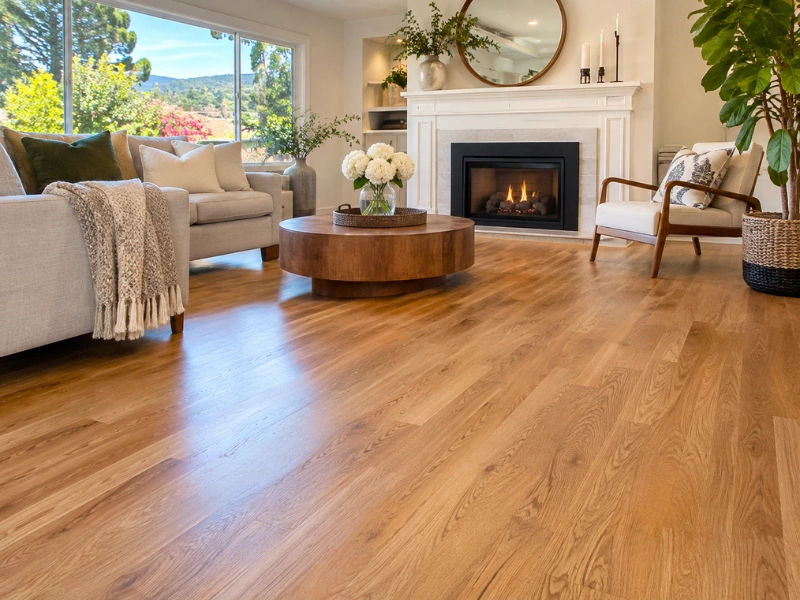
The right hardwood flooring for a Fremont home depends mostly on what’s underneath it. Houses on a raised wood subfloor can take solid hardwood nailed down the traditional way. You’ll see a lot of those in Niles and older parts of Centerville. Homes on a concrete slab usually do better with engineered hardwood, and many later tracts and most of Ardenwood fall into that group. And if there’s original oak hiding under the carpet, refinishing it often beats replacing it.
By Ray Evgeny Khaikin, Owner & General Contractor · Last updated November 20, 2026
Hardwood flooring depends on build year because a Fremont home’s age usually tells you what subfloor it has. Fremont only became a city in 1956. As a result, most of its homes went up between the late 1950s and the 1980s. So builders’ habits from those decades still decide what works today.
This rough guide covers the most common Fremont home types. Every house gets checked in person, of course, because tracts and later additions don’t always follow the pattern.
Fremont home type | What’s usually underneath | What usually works |
Pre-war houses in Niles and old Centerville | Raised wood subfloor, often original oak or fir | Refinish what’s there, or solid hardwood nailed down |
1950s–1970s ranch tracts in Irvington, Glenmoor, Cabrillo and Mission San Jose | Raised floor or slab, depending on the tract | Solid on raised floors, engineered on slab |
1980s–1990s homes in Ardenwood and Warm Springs | Mostly concrete slab | Engineered, glued down or floated over a moisture barrier |
Condos and townhomes | Slab, often with HOA sound rules | Engineered with an approved sound underlayment |
Want a quick check? Look for crawlspace vents along the outside wall near the ground. Vents usually mean a raised floor. No vents and a front step that’s only one stair up usually mean slab.
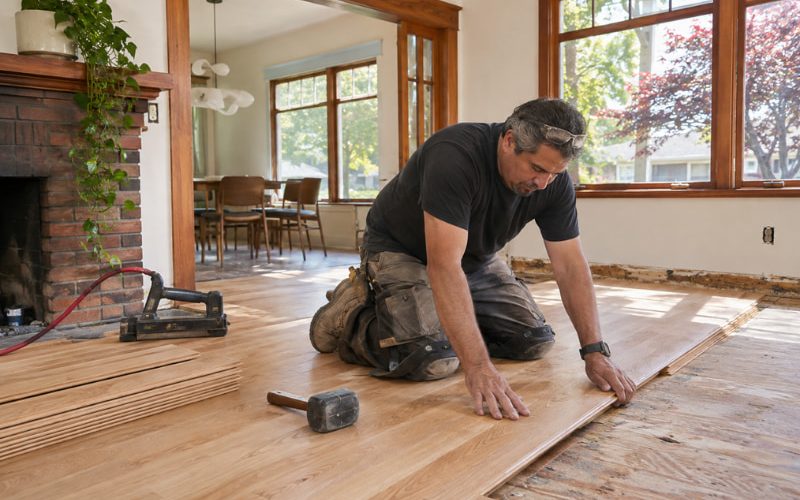
Hardwood flooring installation in Fremont starts below the boards, with the subfloor and moisture. Only then does it move to the wood itself. That order matters, because most failures we see trace back to prep rather than the planks. Cupping, gaps and squeaks are the usual signs.
On a raised floor, the crew checks the plywood or old plank subfloor for soft spots, loose nails and squeaks. Then they fix those first. Older Fremont ranch homes sometimes have diagonal plank subfloors. Those may need extra screws or a new plywood layer before solid wood goes down.
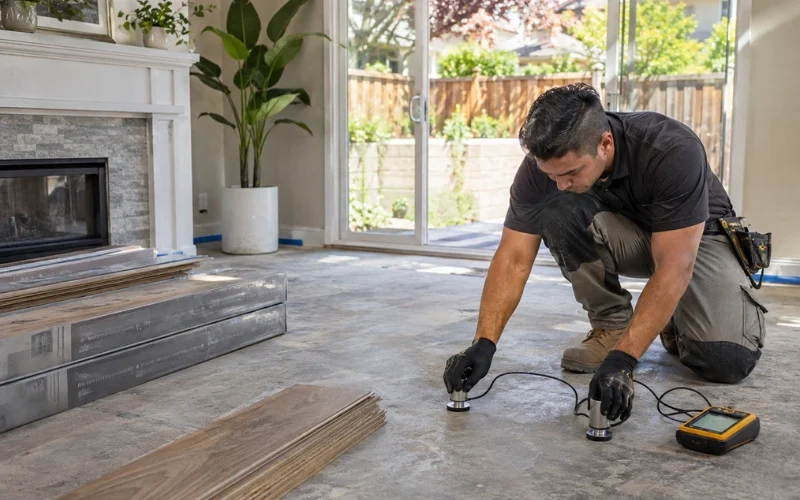
On a slab, the big job is moisture. The concrete gets tested before any wood is ordered. A slab that reads damp will push moisture straight into the floor. If it’s borderline, a moisture barrier or a glue that doubles as one goes down first.
The wood also needs time to settle in. Boards sit in the house for several days so they can adjust to your indoor humidity. Fremont summers are dry, but winter can be damp, especially in the flats toward the bay. Skipping acclimation is one of the most common reasons new floors gap in summer or cup in winter.
Species is the other big decision. Red oak is the value baseline and blends well with the original strip oak in many older Fremont homes. White oak costs a bit more, but it takes modern gray and natural stains more evenly. Harder woods like hickory or maple also stand up better to big dogs and busy kitchens.
After that, the install itself is fairly quick. Most rooms take a day or two, plus trim, transitions to tile or carpet, and stair work if it’s included.
Engineered hardwood flooring makes the most sense in Fremont homes on a concrete slab and in condos. It also helps anywhere humidity swings more than usual. It has a real wood top layer over a cross-layered core. That build makes it much less likely to swell or shrink than a solid board.
It’s also the practical choice when you can’t nail into the floor. Solid hardwood needs a wood subfloor to hold its nails. Engineered planks, on the other hand, can be glued straight to concrete or floated over an underlayment. That suits a lot of Ardenwood and Warm Springs homes.
There’s one thing worth asking about the core. Most engineered flooring uses a plywood-type base, and California regulates how much formaldehyde those composite wood layers can give off. The California Air Resources Board’s composite wood program requires finished flooring to meet its emission standards. It also has to be labeled that way. So ask to see that label on the box before it’s installed.
Thickness matters too. A thicker wear layer can usually be sanded and refinished once or twice. A thin one, however, can only be screened and recoated. If you plan to stay in the house a long time, that’s worth paying a little more for.
Quite often, there’s original oak under the carpet, especially in homes from the 1950s and 1960s. Builders in those years commonly laid strip oak and then carpeted over it. So lift a corner of carpet inside a closet. It’s a free, two-minute way to find out.
Sometimes the find is less welcome, though. Older vinyl tile, sheet flooring and the black adhesive under them can contain asbestos. That’s why it’s smart to test before anyone starts scraping or sanding old layers. The Bay Area Air Quality Management District requires notice before certain removals. That applies at least 10 business days ahead when a renovation takes out 100 square feet or more of asbestos material. A small sample sent to a lab settles the question quickly, and it keeps the project from stalling halfway through.
Is there oak under your carpet, or something you’d rather have checked?
Call: (510) 990-9243
Email: constructionremodelinginbay@gmail.com
Free in-home visit with a written, itemized quote
Hardwood floor refinishing in Fremont is the better choice when the boards are solid, flat and thick enough to sand. That’s true even when the finish looks tired. Scratches, dull traffic paths and old yellowed finish all come off with a full sand and refinish. Gray or black stains from water or pets go deeper, though, and those boards usually need replacing.
A full refinish sands the floor down to bare wood. Then it gets stain if you want a new color and three coats of finish. Dustless sanding and low-VOC waterborne finishes keep the mess and smell down. Plus, a waterborne floor is usually walkable in about a day. Most jobs take three to five days from start to finish.
If the wood is sound and only the top coat is worn, there’s a lighter option. A screen-and-recoat buffs the existing finish and adds a fresh coat without sanding to bare wood. It costs less and takes less time, but it won’t fix deep scratches or a waxed floor.
Solid hardwood can usually be refinished four to six times over its life. That’s why an old oak floor in an Irvington or Mission San Jose ranch often has decades left.
Construction Remodeling in Bay Area handles both new installs and refinishing across Fremont. That includes Niles, Centerville, Irvington, Mission San Jose, Warm Springs and Ardenwood. If you’ve been asking who installs hardwood flooring in Fremont, our crew is based just up I-880 in Hayward. It’s our own carpenters on the job, not a rotating list of subcontractors.
When you’re comparing options for the best hardwood flooring installer near Fremont, a few things are worth checking:
We work throughout the area too, including Union City and Hayward. For more on Fremont projects beyond flooring, see our Fremont remodeling page. Our flooring installation page shows every floor type we lay. You can also read more about our hardwood flooring service. Our post on hardwood flooring costs in Mountain View covers how slab condos change the math farther south.
Whatever your house sits on, good hardwood flooring comes down to two things. Match the wood to the subfloor, then take the time to prep it right.
Hardwood flooring in Fremont typically costs about $12 to $18 per square foot installed for engineered and $14 to $22 for solid, with wide planks and premium species at the higher end. Anyone asking how much does hardwood flooring cost installed, or how much does hardwood flooring cost per square foot, should also budget for demo, subfloor prep and stairs at $100 to $250 per tread, which a good quote lists separately.
Yes, we offer a free in-home visit where we measure every room and check the subfloor before pricing anything. You then get a written, itemized quote, and nothing changes later without a written re-quote.
Engineered is usually better on a concrete slab, in condos and in rooms with humidity swings, while solid is the stronger long-term choice over a raised wood subfloor because it can be refinished many more times. For anyone weighing is engineered or solid hardwood better, your foundation decides it first and how long you plan to stay decides it second.
Yes, we refinish existing hardwood, including full sand-and-refinish jobs, screen-and-recoats, and board repairs, as well as installing new floors. If you’ve been searching which flooring company near me refinishes hardwood floors, we can look at yours and tell you honestly whether refinishing or replacing makes more sense.
Yes, removing and hauling away the old flooring is a standard part of the job and shows up as its own line item on the quote. Glued-down flooring or tile takes more labor than carpet, so the price reflects what’s actually coming up.
Construction Remodeling in Bay Area
Address: 111 Jackson St, Hayward, CA 94544
Phone: (510) 990-9243
Email: constructionremodelinginbay@gmail.com
Hours: Mon–Thurs 8 AM–6 PM; Fri–Sun 9 AM–4 PM
Licensed general building contractor since 2015 (CSLB #1095283), with a 5-year workmanship warranty
Serving Fremont, Union City, Hayward, Castro Valley, San Leandro and the wider Bay Area. Call for a free estimate, or use our contact page to book a visit.